
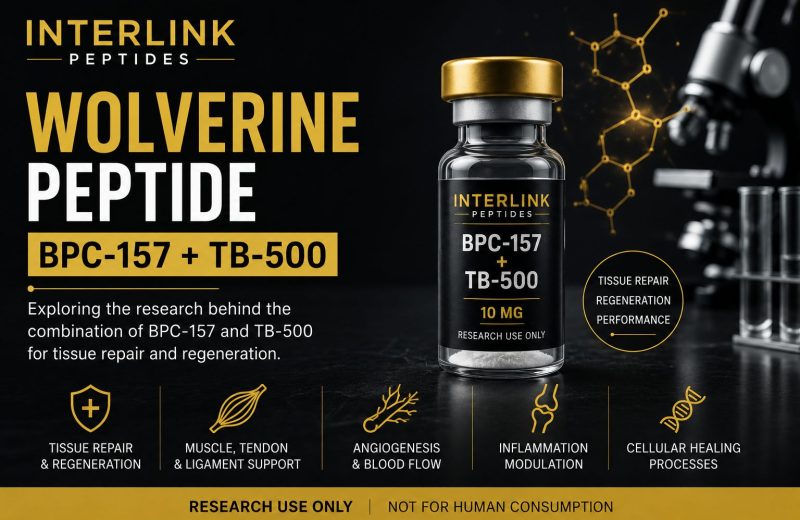
The Wolverine peptide is the popular name given to the combination of BPC-157 and TB-500, two research peptides that have generated considerable interest in the study of tissue repair and regenerative biology.
Rather than being a single compound, the Wolverine combination brings together two peptides associated with different biological processes involved in repair, recovery and regeneration.
Research surrounding BPC-157 has explored areas including tendon and ligament tissue, muscle injury, angiogenesis, inflammation and gastrointestinal protection. Research associated with thymosin beta-4 has investigated cell migration, blood-vessel formation, wound repair and tissue regeneration.
These complementary areas of research help explain why BPC-157 + TB-500 have become one of the most widely discussed peptide combinations.
What Is the Wolverine Peptide?
The Wolverine peptide isn’t actually a single peptide. It’s an informal nickname commonly used for the combination of BPC-157 and TB-500.
The name is inspired by Wolverine, the fictional character famous for his extraordinary regenerative ability.
Within peptide research communities, the term has become associated with BPC-157 and TB-500 because both compounds have attracted research interest surrounding biological processes involved in tissue repair, regeneration and recovery.
Although their areas of research overlap, BPC-157 and TB-500 are distinct compounds with different proposed mechanisms. This is one reason the combination has generated so much interest.
What Is BPC-157?
BPC-157 (Body Protection Compound-157) is a synthetic peptide consisting of 15 amino acids.
It has become one of the most widely discussed research peptides because experimental studies have investigated its activity across numerous biological systems.
Research involving BPC-157 has explored areas including tendon and ligament tissue, skeletal muscle injury, wound repair, angiogenesis, inflammatory processes and gastrointestinal tissue.
Of particular interest are experimental studies investigating interactions between BPC-157 and mechanisms involved in blood-vessel formation and tissue repair.
These findings have made BPC-157 an increasingly prominent compound within regenerative peptide research.
What Is TB-500?
TB-500 is a synthetic research peptide associated with the biology of thymosin beta-4 (Tβ4).
Thymosin beta-4 is a naturally occurring 43-amino-acid peptide found in many tissues throughout the body and has been extensively investigated for its role in cellular processes associated with repair and regeneration.
Research surrounding thymosin beta-4 has explored cell migration, angiogenesis, wound healing, inflammation and tissue regeneration.
TB-500 itself is a distinct research compound and shouldn’t automatically be considered identical to full-length thymosin beta-4. However, the biological pathways associated with thymosin beta-4 are a major reason TB-500 has attracted considerable research interest.
Why Are BPC-157 and TB-500 Researched Together?
BPC-157 and TB-500 are frequently discussed together because the research surrounding them involves different but potentially complementary processes associated with tissue repair and regeneration.
BPC-157 research has explored areas including angiogenesis, fibroblast activity, tendon and ligament tissue, muscle injury and inflammatory pathways.
Thymosin beta-4 research has investigated cell migration, blood-vessel formation, wound repair and tissue regeneration.
This creates an interesting research rationale: rather than examining two compounds associated with exactly the same mechanism, researchers can investigate compounds connected with different elements of the wider biological repair process.
This complementary research profile is at the heart of the Wolverine peptide combination.
A 2026 preclinical study directly investigated BPC-157, TB-500 and their combination in an Achilles tendon injury model, assessing tendon healing through biomechanical, histopathological and immunohistochemical analysis.
Why Has the Wolverine Peptide Attracted So Much Interest?
Interest in the Wolverine peptide stack has grown rapidly because both BPC-157 and TB-500 are associated with some of the most active areas of regenerative research.
Scientists studying tissue repair are interested in several interconnected processes, including:
Angiogenesis — the formation of new blood vessels.
Cell migration — the movement of cells toward areas where biological repair is taking place.
Fibroblast activity — cells involved in producing components of connective tissue.
Inflammatory signalling — biological pathways involved in the body’s response to tissue damage.
Tissue remodelling — the processes through which damaged tissue is repaired and reorganised.
Research surrounding BPC-157 and thymosin beta-4 intersects with several of these mechanisms, which helps explain the continuing scientific interest surrounding these peptides.
BPC-157 vs TB-500: What’s the Difference?
Although BPC-157 and TB-500 are frequently combined under the Wolverine name, they are two different research peptides.
BPC-157 is a 15-amino-acid synthetic peptide. Research has investigated its potential interactions with angiogenesis, connective tissue, gastrointestinal protection, inflammatory pathways and several models of tissue injury.
TB-500 is associated with thymosin beta-4 biology. Research surrounding thymosin beta-4 has focused heavily on actin regulation, cell migration, angiogenesis, wound repair and regenerative processes.
The differences between their research profiles are actually one of the main reasons the two compounds are so frequently discussed together.
BPC-157 and Tendon & Ligament Research
One area responsible for much of the interest surrounding BPC-157 is tendon and ligament research.
Experimental studies have investigated BPC-157 in models involving injured tendons and other connective tissues, including research examining fibroblast activity and mechanisms associated with tendon healing.
Tendons naturally have relatively limited blood supply compared with many other tissues, making tendon repair a particularly interesting area of regenerative research.
BPC-157’s experimental relationship with angiogenesis and connective-tissue repair has therefore attracted considerable attention.
TB-500 and Tissue Repair Research
The research surrounding thymosin beta-4 provides another interesting area of regenerative biology.
Thymosin beta-4 has been investigated in relation to cell migration, angiogenesis, wound healing and tissue regeneration.
One particularly interesting biological characteristic is its interaction with actin, an important protein involved in cellular structure and movement.
Cell movement is fundamental to numerous repair processes because cells must migrate toward damaged tissue during healing and regeneration.
This provides an important biological basis for continuing research into thymosin beta-4-related compounds.
Does Combining BPC-157 and TB-500 Create a Synergistic Effect?
This is one of the biggest questions surrounding the BPC-157 + TB-500 Wolverine combination.
Because the two compounds are associated with different aspects of regenerative biology, there is considerable interest in whether their mechanisms could potentially complement one another.
BPC-157 research has investigated connective tissue, angiogenesis and several repair pathways, while thymosin beta-4 research has investigated cell migration, actin regulation, angiogenesis and wound repair.
This provides an interesting theoretical research rationale for examining the compounds together.
However, synergy between BPC-157 and TB-500 has not yet been established through robust controlled human clinical trials. It therefore remains an interesting research hypothesis rather than a clinically proven effect.
What Does Current Research Tell Us?
The scientific interest surrounding both peptides is substantial, but the maturity of the evidence differs considerably depending on the compound and research area.
BPC-157 has generated a significant body of preclinical research, particularly involving animal and laboratory models.
Thymosin beta-4 has a broader research literature and has also been investigated in humans in certain contexts.
An important distinction is that studies involving full-length thymosin beta-4 should not automatically be treated as studies of TB-500.
Human research specifically examining BPC-157 and TB-500 remains much less developed than the experimental literature.
This doesn’t remove the scientific interest surrounding the compounds; rather, it highlights why further controlled research is needed to determine whether promising experimental findings translate into reproducible human outcomes.
Is the Wolverine Peptide Approved for Human Use?
BPC-157 and TB-500 remain research compounds rather than established approved medicines for injury recovery.
Neither should therefore be presented as an approved treatment for tendon, ligament or muscle injuries.
The regulatory status is an important distinction between experimental peptide research and established clinical medicine.
For researchers, however, the continuing investigation of the biological pathways associated with these compounds makes them an interesting area within regenerative science.
The Bottom Line
The Wolverine peptide has become one of the best-known combinations in peptide research, bringing together BPC-157 and TB-500.
The scientific interest is understandable. Research surrounding BPC-157 has explored connective tissue, angiogenesis, inflammation and several models of tissue repair, while research associated with thymosin beta-4 has investigated cell migration, actin regulation, wound healing and regeneration.
Their differing research profiles create an interesting rationale for studying the compounds alongside one another and investigating whether their biological mechanisms could potentially complement each other.
There is still a considerable gap between promising experimental research and demonstrating clinical effectiveness in humans, particularly for the combination itself. That unanswered question is also precisely why BPC-157 and TB-500 continue to attract research interest.
For research purposes only. This article is provided for scientific and educational information and does not constitute medical advice or recommend human use.