
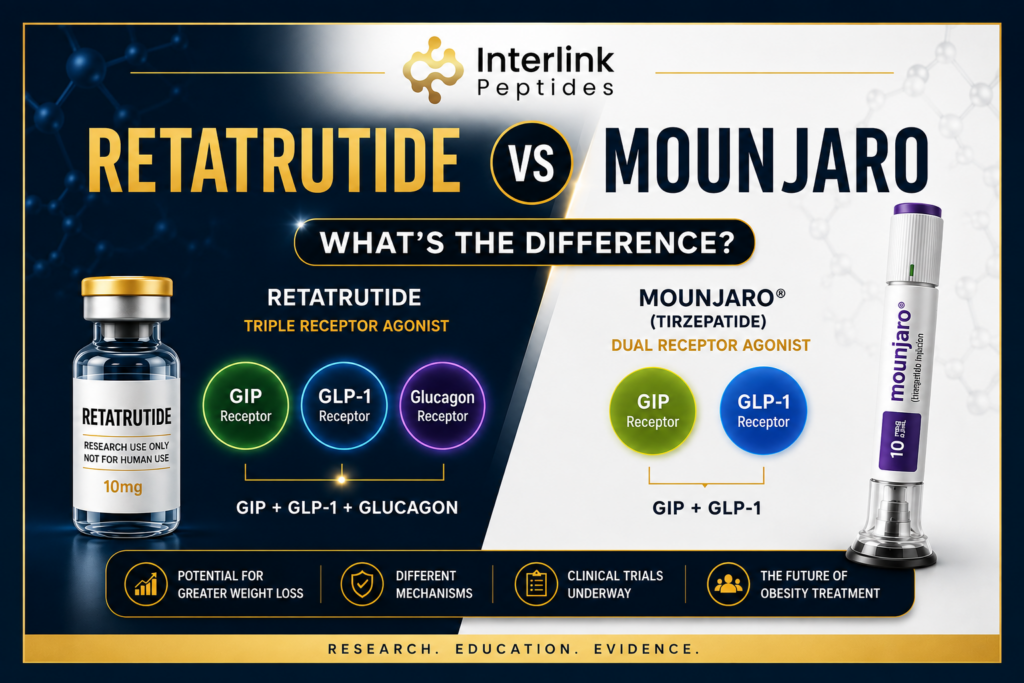
Retatrutide vs Mounjaro is a comparison attracting significant attention in obesity and metabolic research, but they are not the same compound.
Mounjaro is the brand name for tirzepatide, a medicine authorised in the UK for type 2 diabetes and weight management in eligible adults. Retatrutide is a newer investigational compound that targets three hormone receptors rather than two.
So, how does retatrutide compare with Mounjaro, and does the current research suggest one could be more effective than the other?
In this comparison, we’ll look at how they work, clinical trial results, side effects, their current UK status and what the research actually tells us.
| Feature | Retatrutide | Mounjaro (Tirzepatide) |
| Receptor targets | 3 | 2 |
| GLP-1 | ✓ | ✓ |
| GIP | ✓ | ✓ |
| Glucagon | ✓ | — |
| UK Status | Investigational | Authorised Medicine |
Updated August 2026: This comparison article has been updated to include the latest Phase 3 TRIUMPH-1 retatrutide results, including weight-loss data reported at 80 and 104 weeks. Earlier Phase 2 findings are included for context.
What is Mounjaro (Tirzepatide)?
Mounjaro is the brand name for tirzepatide, a medicine developed by Eli Lilly. Tirzepatide acts as a dual GIP and GLP-1 receptor agonist, meaning it targets two hormone receptors involved in metabolic regulation.
GLP-1 and GIP signalling can influence appetite, food intake, insulin secretion and blood glucose regulation. This dual mechanism is what distinguishes tirzepatide from medicines that target the GLP-1 receptor alone.
In the UK, Mounjaro is authorised for the treatment of type 2 diabetes and for weight management in eligible adults. This is an important difference when comparing it with retatrutide: Mounjaro is an authorised medicine, while retatrutide remains an investigational compound.
What is Retatrutide?
Retatrutide, also known by its development code LY3437943, is an investigational compound developed by Eli Lilly. It is being studied for its potential effects on obesity and other metabolic conditions.
Unlike tirzepatide, which targets two hormone receptors, retatrutide acts on three: GLP-1, GIP and glucagon receptors. Because of this, it is commonly described in research as a triple receptor agonist.
The additional glucagon receptor activity is the key difference between retatrutide and tirzepatide. Researchers are investigating whether this three-receptor approach could produce additional metabolic effects beyond those seen with GLP-1/GIP agonism alone.
Retatrutide is currently investigational and is not an authorised medicine in the UK. Its efficacy and safety continue to be evaluated through clinical trials.
Retatrutide vs Mounjaro: How Do They Work?
Both retatrutide and Mounjaro (tirzepatide) interact with hormone receptors involved in appetite, blood glucose regulation and energy balance, but their mechanisms are not identical.
Tirzepatide targets two receptors: GIP and GLP-1. GLP-1 signalling can help reduce appetite and slow gastric emptying, while both GLP-1 and GIP are involved in glucose-dependent insulin secretion.
Retatrutide targets the same GIP and GLP-1 receptors but adds glucagon receptor activity. Glucagon has a different metabolic role and is associated with processes including energy expenditure and the regulation of glucose and fat metabolism.
This additional receptor does not automatically mean that retatrutide is “better” or more effective. Instead, the triple-receptor mechanism is one of the main reasons researchers are studying whether retatrutide could produce different metabolic effects from dual GIP/GLP-1 agonists such as tirzepatide.
Retatrutide vs Mounjaro for Weight Loss: What Do the Trials Show?
Both retatrutide and tirzepatide have produced substantial reductions in body weight in clinical trials. However, the results come from separate studies with different participants, treatment periods and study designs, so the headline percentages should not be treated as a direct head-to-head comparison.
Earlier Phase 2 research into retatrutide reported an average body-weight reduction of up to 24.2% after 48 weeks. Since then, larger Phase 3 trials have provided newer evidence on its potential effects.
In the Phase 3 TRIUMPH-1 trial, retatrutide was studied in adults with obesity or overweight and at least one weight-related complication who did not have diabetes. At 80 weeks, participants receiving the 12 mg dose experienced an average weight reduction of 28.3%, while those receiving 4 mg lost an average of 19.0%.
A group of participants with a starting BMI of at least 35 continued into an extension of the study. At 104 weeks, participants receiving 12 mg retatrutide achieved an average weight reduction of 30.3%.
Tirzepatide has also demonstrated substantial weight reduction. In the Phase 3 SURMOUNT-1 trial, which included 2,539 adults with obesity or overweight and at least one weight-related complication without diabetes, average weight reductions after 72 weeks were 15.0% with 5 mg, 19.5% with 10 mg and 20.9% with 15 mg, compared with 3.1% with placebo.
Although the headline results for retatrutide are higher, there has not been a direct clinical trial comparing retatrutide with tirzepatide. Differences in study duration, populations and trial design mean these percentages cannot establish that one treatment produces greater weight loss than the other.
Those numbers are supported by the latest TRIUMPH-1 data and the peer-reviewed SURMOUNT-1 results.
| Trial | Retatrutide TRIUMPH-1 | Tirzepatide SURMOUNT-1 |
|---|---|---|
| Trial phase | Phase 3 | Phase 3 |
| Participants | Adults with obesity/overweight* | 2,539 |
| Main comparison period | 80 weeks | 72 weeks |
| Highest-dose result | −28.3% (12 mg) | −20.9% (15 mg) |
| Drug status | Investigational | Authorised medicine |
Is Retatrutide Better Than Mounjaro?
Based on the evidence currently available, it is not possible to say definitively that retatrutide is better than Mounjaro (tirzepatide).
Retatrutide has produced substantial weight loss in clinical trials. More recent Phase 3 TRIUMPH-1 results reported an average body-weight reduction of 28.3% at 80 weeks with the 12 mg dose, with a subgroup of participants with a starting BMI of at least 35 achieving an average reduction of 30.3% at 104 weeks.
These results have increased interest in retatrutide, particularly because its GIP, GLP-1 and glucagon triple-receptor mechanism differs from the dual GIP and GLP-1 mechanism of tirzepatide.
However, the headline percentages should not be used to conclude that retatrutide is more effective than Mounjaro. The drugs have not been compared directly in a head-to-head clinical trial, and differences in study populations, trial duration and design make comparisons between separate trials unreliable.
Mounjaro also has an important advantage in the strength and maturity of its evidence. Tirzepatide has been studied extensively across multiple Phase 3 trials and is already an authorised medicine in the UK, while retatrutide remains investigational.
The evidence therefore suggests that retatrutide has considerable potential, but a direct comparison would be needed to establish whether it is more effective than Mounjaro.
Retatrutide Vs Mounjaro: Side Effects and Safety
Both retatrutide and Mounjaro (tirzepatide) can cause side effects, with gastrointestinal symptoms among the most commonly reported adverse events in clinical trials.
The newer Phase 3 TRIUMPH-1 trial provides more detailed safety information for retatrutide. The most commonly reported side effects included nausea, diarrhoea, constipation and vomiting, with gastrointestinal side effects also being the most common reason participants discontinued treatment.
At the 12 mg retatrutide dose, nausea was reported in 42.4% of participants, diarrhoea in 32.0%, constipation in 26.1% and vomiting in 25.3%. Researchers also reported other adverse events including dysesthesia (altered skin sensations) and urinary tract infections. Most of these events were described as mild to moderate.
Tirzepatide has similarly been associated with gastrointestinal side effects, particularly nausea, diarrhoea, constipation and vomiting. These effects commonly occur while doses are being increased.
An important difference is the amount of safety evidence currently available. Tirzepatide has been studied extensively across clinical trials and is already an authorised medicine in the UK. Retatrutide remains investigational, and although Phase 3 data have substantially increased the available evidence, its longer-term safety profile continues to be evaluated.
Neither treatment should be considered risk-free, and results from separate clinical trials cannot establish that one has a better overall safety profile than the other.
Retatrutide vs Tirzepatide: Are They the Same?
No. Retatrutide and Tirzepatide are different compounds, although they share some similarities in how they work.
Tirzepatide is the active ingredient in Mounjaro and targets the GIP and GLP-1 receptors. Retatrutide also targets GIP and GLP-1 but adds glucagon receptor activity, giving it a three-receptor mechanism.
This means that searches for “retatrutide vs tirzepatide” and “Retatrutide vs Mounjaro” are essentially asking the same comparison, because Mounjaro is a brand name for Tirzepatide.
The simplest distinction is:
Mounjaro (tirzepatide) = GIP + GLP-1
Retatrutide = GIP + GLP-1 + glucagon
Is Retatrutide Available in the UK?
Retatrutide is not currently an authorised medicine in the UK. It remains an investigational drug being evaluated in clinical trials.
This is different from Mounjaro (tirzepatide), which is authorised by the MHRA for specific medical uses in the UK.
Although retatrutide has produced promising results in clinical research, it has not yet completed the regulatory process required for it to be prescribed as an approved medicine.
Retatrutide should therefore not be confused with an approved weight-loss treatment. Its safety, effectiveness and longer-term effects continue to be investigated in clinical trials.
When Could Retatrutide Become Available?
Retatrutide is still undergoing clinical development, and there is currently no confirmed date for when it could become available as an approved medicine in the UK.
Eli Lilly has now reported positive Phase 3 results from several studies in its TRIUMPH clinical trial programme, including TRIUMPH-1, TRIUMPH-2 and TRIUMPH-3. However, completing successful Phase 3 trials does not itself mean that a medicine is approved for general use.
In July 2026, Lilly stated that it plans to submit retatrutide to the US FDA in the first quarter of 2027. A UK approval timetable has not been confirmed.
There has also been regulatory activity in the UK. In July 2026, the MHRA agreed a paediatric investigation plan for retatrutide for obesity and overweight. This is part of the medicine-development process and should not be confused with approval for retatrutide to be prescribed or marketed in the UK.
Retatrutide would still need to complete the relevant regulatory process before becoming an authorised medicine in the UK. Therefore, any specific UK launch date currently suggested online should be treated as an estimate rather than a confirmed date.
As of August 2026, retatrutide remains investigational and is not approved for general medical use in the UK.
Frequently Asked Questions
Is retatrutide the same as Mounjaro?
No. Retatrutide and Mounjaro are different compounds. Mounjaro contains tirzepatide and targets the GIP and GLP-1 receptors, while retatrutide targets GIP, GLP-1 and glucagon receptors.
Is Retatrutide the same as Tirzepatide?
No. Tirzepatide is the active ingredient in Mounjaro. Retatrutide is a separate investigational compound with an additional glucagon receptor mechanism.
Does retatrutide cause more weight loss than Mounjaro?
Retatrutide has produced larger headline weight-loss percentages in some clinical trials, including recent Phase 3 research. However, retatrutide and tirzepatide have not been directly compared in a head-to-head clinical trial, so these results do not prove that retatrutide causes greater weight loss than Mounjaro.
Is retatrutide approved in the UK?
No. As of August 2026, retatrutide is not an authorised medicine in the UK and remains investigational. Mounjaro (tirzepatide), by comparison, is an authorised medicine in the UK.
When will retatrutide be available in the UK?
There is currently no confirmed UK availability date for retatrutide. Phase 3 development has progressed, but regulatory approval would still be required before it could be marketed as an authorised medicine in the UK.
Retatrutide vs Mounjaro: The Bottom Line
Retatrutide and Mounjaro (tirzepatide) are both incretin-based treatments that have produced substantial weight-loss results in clinical trials, but they are at very different stages of development.
Mounjaro is an authorised medicine with a much larger body of clinical and real-world evidence behind it. Retatrutide remains investigational, although results from the Phase 3 TRIUMPH programme have strengthened the evidence for its potential as an obesity treatment.
Retatrutide’s main scientific difference is its triple receptor mechanism, targeting GIP, GLP-1 and glucagon receptors, compared with the dual GIP and GLP-1 action of tirzepatide.
Although the headline weight-loss results reported for retatrutide are impressive, the available trials were not direct head-to-head comparisons with Mounjaro. It is therefore too early to conclude that retatrutide is definitively more effective or safer than tirzepatide.
For now, the clearest distinction is that Mounjaro is an established, authorised medicine, while retatrutide remains a promising investigational treatment undergoing clinical development.
Sources and References
- Jastreboff AM, et al. Triple–Hormone-Receptor Agonist Retatrutide for Obesity — A Phase 2 Trial. New England Journal of Medicine. 2023;389:514–526. View the study in NEJM
- Eli Lilly and Company. TRIUMPH-1: Phase 3 study of retatrutide in people with obesity. Includes the latest Phase 3 results and the 80-week and 104-week data we’ve used in the article. View TRIUMPH-1 results
- Jastreboff AM, et al. Tirzepatide Once Weekly for the Treatment of Obesity (SURMOUNT-1). New England Journal of Medicine. 2022;387:205–216. View the SURMOUNT-1 study in NEJM
- Medicines and Healthcare products Regulatory Agency (MHRA). Mounjaro (tirzepatide) authorised for weight management and weight loss in the UK. View the MHRA announcement
Nice article – really informative and helpful.
Thanks. This helped me understand the difference as there is so much info out there and it can be confusing.